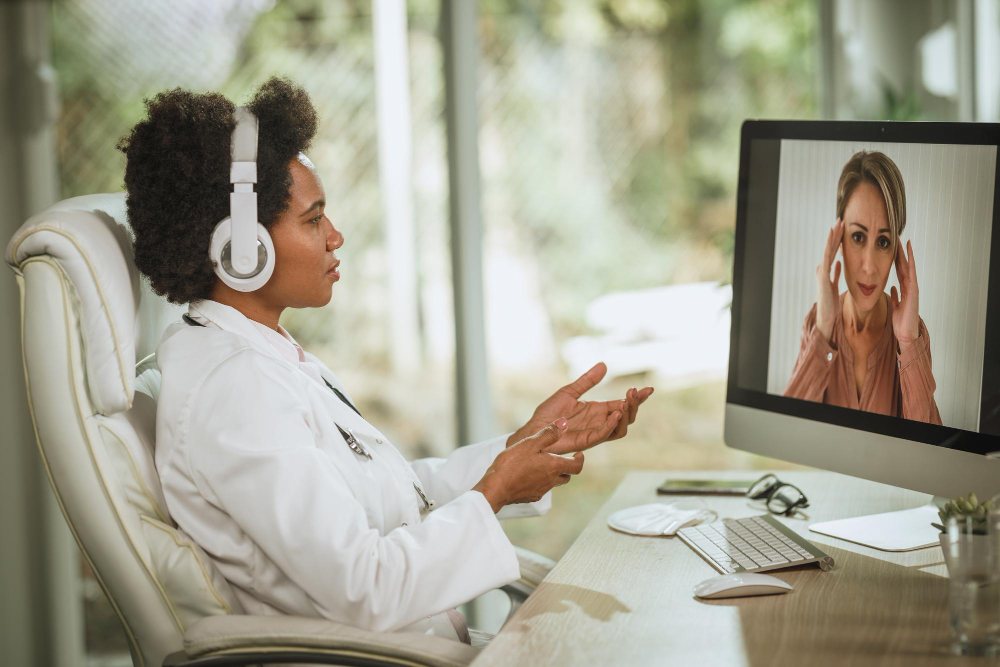

Africa’s healthcare landscape is transforming. With telemedicine, AI diagnostics, and mobile health platforms, access to medical services is improving even in the most remote areas.
Picture this: a small rural clinic in South Sudan, and a patient sitting comfortably, tapping on a tablet. A doctor somewhere else logs in, reviews data, consults, prescribes. What seemed futuristic a few years back is now becoming more real. Thanks to technologies like telemedicine, mobile-health apps and digital health platforms, we at Trimverse believe that healthcare can — and should — be accessible to everyone, everywhere.

Why it matters:
- Many African regions still struggle with physical infrastructure, specialist availability, and travel barriers. But digital health is changing that. For example, the World Health Organization notes that the use of mobile phones and ICT in Africa is creating opportunities to “treat patients, educate the health workforce, track diseases and monitor public health.” WHO | Regional Office for Africa+2WHO | Regional Office for Africa+2
- Telemedicine in Sub-Saharan Africa has been shown to reduce the gap in access: one review found that although challenges remain, it holds strong promise for rural and underserved communities. MDPI+1
- At Trimverse, our mission aligns with this: offering remote consultations, mobile health platforms, and smarter tools so that geography isn’t a barrier to quality care.
How technology is bridging the gap:
- Telemedicine & remote consultations – Patients can connect with doctors through video, chat or phone, even from remote areas.
- Mobile health (mHealth) – Apps for scheduling appointments, accessing prescriptions, monitoring chronic health conditions — right on a smartphone.
- Digitised records & connectivity – When health data travels with the patient and is available to providers, continuity of care improves.
- Smart diagnostics & wearables – These tools detect early warning signs, alert clinicians, and lead to quicker intervention.
Real-life twist:
Imagine a patient in a village near Juba using a simple smartphone app to book a follow-up after surgery, and a Trimverse-enabled clinic receiving the record, a specialist reviewing remotely, a wearable tracking vitals in real-time. No long bus rides. No waiting days. Better outcomes, less stress.
Challenges and our approach:
It’s not magic. Implementing digital health in Africa comes with hurdles: internet connectivity, device access, infrastructure, training healthcare workers, regulation. WHO | Regional Office for Africa+1 At Trimverse, we aim to design solutions with low-bandwidth compatibility, support via mobile and SMS, local language interfaces, and training programmes for health staff.
What this means for the future:
The gap between rural and urban health access is narrowing. Patients no longer need to travel vast distances for specialist advice. Providers can leverage data, devices and connectivity to make smarter decisions. At Trimverse, we envisage a South Sudan where everybody can receive top-tier health advice on their phone, their wearable, or via teleconsultation.
Takeaway:
Technology is more than just cool gadgets. It’s a bridge. It’s about making care equitable, convenient and high quality. With telemedicine, mobile tools, smart diagnostics and digital records, we’re building the future of healthcare in Africa — and it starts now.